

Networks are leaving the ground.
That used to sound like science fiction. It does not anymore. LEO is filling with machines that route, relay, measure, and carry traffic. MEO and GEO are already part of the communications fabric. The Moon is becoming a place where systems will work, fail, recover, and need to move data. Lagrange points will matter. Mars will matter. The long space between those places will matter.
This is not one terrestrial network lifted upward.
It is a stack of regimes, each with its own physics. LEO moves fast. GEO looks almost nailed to the sky. A lunar surface link does not behave like a satellite crosslink. An Earth–Moon relay is not a terrestrial backbone with a longer cable. Mars is not a distant data center. At closest approach, light still needs minutes to get there. At worst, the Sun is in the way and there is no conversation to be had.
All of those networks will need to talk.
That is the part worth caring about. Not because space is romantic. The work matters because the assumptions under our routing systems were built in a world where the important things were close, mostly fixed, and reachable often enough that reacting after the fact looked like intelligence.
The next network will not be that well behaved.
On the ground, topology is something you draw. You put routers in buildings, towers, vehicles, ships, aircraft, and racks. You connect them with fiber, microwave, copper, radio, or whatever the budget and physics allow. Links fail. Optics die. Towers lose power. Fiber gets cut. Bad maintenance windows happen.
Still, the bones stay where you put them.
A terrestrial routing protocol lives inside that bargain. IS-IS, OSPF, BGP, LDP, segment routing, traffic engineering. All of it assumes that topology is mostly stable and change is news. A neighbor disappears. A route is withdrawn. A link comes back. The protocol detects the fact, floods it, computes a new answer, and installs forwarding state.
Detect, flood, compute, install.
It is exactly right for a network made of fixed things occasionally having a bad day.
Space is not having a bad day.
Space is motion, distance, delay, shadow, visibility, and geometry. A LEO satellite moves about seven and a half kilometers every second. A ground station sees it, uses it, loses it, and picks another. A cross-plane link can exist for a few minutes because two antennas can track each other, then disappear because the geometry no longer permits it. A lunar relay may be predictable for hours and still be the wrong answer for a low-delay path. A Mars link may be perfectly healthy and still too far away for instincts born in a metro network.
The link did not fail.
The universe moved.
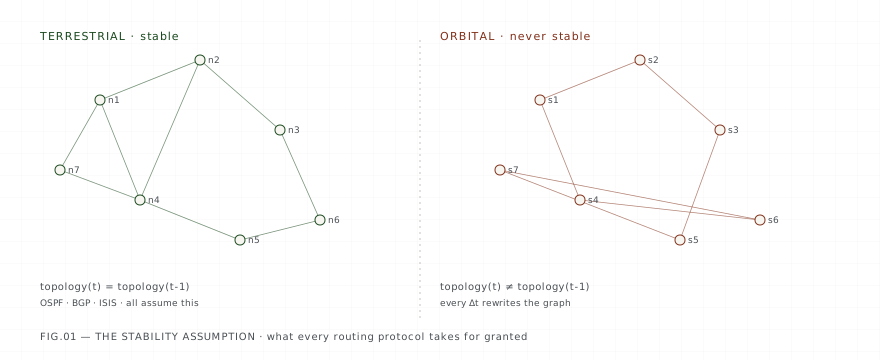
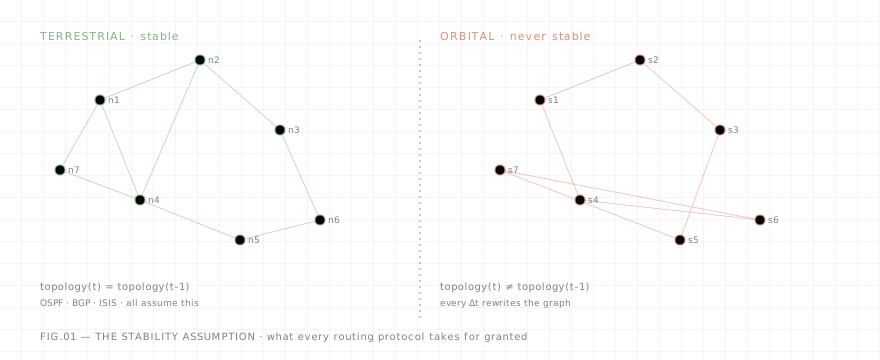
That is the first thing to get straight. Failure and motion are not the same thing. Terrestrial networking treats topology change as an event. Space makes topology change part of the medium. Some links are scheduled. Some delays are baked into physics. Some outages are not outages at all. They are the shape of the system.
Once you see that, the old routing model starts to look peculiar. It waits to discover facts that orbital mechanics already knew. It treats predictable transitions like surprises. It spends convergence time reacting to events that were sitting in the future all along, waiting for the clock to arrive.
That is the terrestrial assumption problem.
The protocols were bred for dirt. They assume distance is small enough, delay is manageable enough, topology is stable enough, and reaction is fast enough. Those assumptions are not foolish. They built the Internet. They run the world.
But they are local truths.
Move the network into orbit, across the Moon, through relay points, and eventually between planets, and local truth becomes dangerous if you mistake it for universal law. You can still use pieces of the old machinery. You should. IS-IS, OSPF, BGP, MPLS, segment routing, traffic engineering, policy. None of that knowledge gets thrown away.
The mistake is assuming the old instincts survive unchanged.
They will not.
So we need a place to break the assumptions before the assumptions break the network.
That is why NodalArc exists.
NodalArc is a lab for this new frontier. You define the constellation, the ground stations, the satellite hardware, the routing stack, and the time model. Then you make real routing implementations live inside the geometry. Real Linux namespaces. Real FRR. Real kernel interfaces. Real carrier changes. Real packets crossing paths that exist because the sky says they exist.
That distinction matters. A model of IS-IS is somebody's opinion about IS-IS. FRR running IS-IS across real interface changes is IS-IS having to answer for itself.
The point is not to crown a protocol or bury one.
The point is to find out what changes when the network stops standing still.
Start with LEO because LEO is close enough to build, fast enough to hurt, and rich enough to expose the problem. Then widen the frame. Add different orbital regimes. Add lunar relays. Add long-delay paths. Add ground stations that hand off. Add forwarding strategies that know the future instead of waiting for the present to surprise them. Run the same experiment again with one variable changed.
That is the work this blog is for.
Some of it will be argument. A bad assumption deserves to be named before it gets promoted into architecture. Some of it will be explanation, because terrestrial network engineers have a great deal of hard-earned instinct, and not all of that instinct transfers cleanly into space. Some of it will be mechanism: how NodalArc turns orbital geometry into carrier state, how a scheduler decides what should exist, how a Node Agent makes the kernel obey, how FRR behaves when the ground keeps moving underneath it.
And some of it will be results. That part matters most. It is easy to have opinions about whether IS-IS can survive a moving constellation. It is easy to say BGP is too slow, or OSPF is too chatty, or proactive forwarding is obviously the answer. Easy claims are cheap. Measurements cost more. They also tell the truth with less drama.
So the shape here is simple. State the assumption. Build the experiment. Run it. Read what comes back. If the result makes the assumption look foolish, good. Better the assumption bleed in the lab than in the network.
NodalArc is the tool for that job. NodalPath will enter later, when the question stops being "can the old routing machinery keep up?" and becomes "what would we build if we accepted that the future is already available?" One comes before the other. First you make the old model stand in the moving world and see where it bends. Then you decide what needs replacing.
Not by declaring terrestrial networking obsolete. It is not.
By admitting that the old rules were written for one environment, and we are now building in another.
The first thing to understand is geometry. Before routing can succeed or fail, the universe decides which links can exist, how long they last, and how expensive they are.
The graph draws itself. We have to learn how to route through it.
post 002 (Addressing the Geometry Problem) starts with that graph: how a constellation becomes a network, why Walker patterns matter, and why the links your routing protocol sees are really geometry wearing an interface name.