

NodalPath starts from a fact NodalArc makes hard to ignore: in orbital networks, the topology is not merely changing. It is scheduled by physics. NodalPath treats that schedule as the control-plane input.
It consumes a forecast of candidate connectivity, computes a forward calendar of network state, distributes that schedule before the geometry changes, and verifies what actually happened. Computing a path across the current topology is the easy fraction. Forecasting when the topology changes and staging the response before it happens is the hard majority.
The first proving ground is NodalArc, because an emulator gives NodalPath a moving world with a clock, a geometry, and ground truth. That is the bench, not the boundary. The product direction is broader: NEBULA-style forwarding almanacs, Spacetime-style scheduled control entries, and eventually higher-regime contact plans where the control channel is intermittent because physics says so.
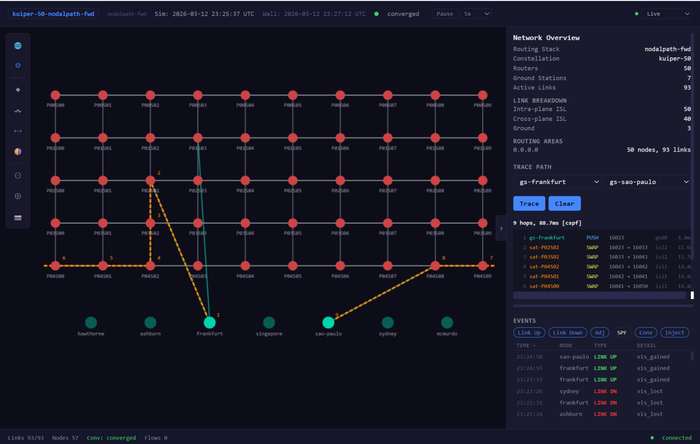
Architecture
NodalPath is not another routing protocol. It is the layer that asks what the network should already know before motion turns into failure. The architecture is built around a clean split: the world publishes the forecast, NodalPath computes the schedule, nodes enact the schedule, and telemetry proves whether intent became reality.
World contract. NodalPath does not own orbital mechanics or link physics. It consumes a published forecast: candidate links, committed contacts, clock, ephemeris, link state, and telemetry. NodalArc is the first world that can satisfy that contract. A real constellation, a ground system, or another emulator should be able to satisfy it later.
Temporospatial core. The core works over validity windows, not a frozen graph. Links exist for intervals. Latency and capacity change with range. The solver plans over that forward view and recomputes when the epoch, the intent, or the realized world says the old answer is no longer enough.
Canonical schedule. NodalPath's central artifact is a transport-neutral schedule: epochs, activation conditions, atomic groups, forwarding entries, and status proof. NEBULA can see it as a forwarding almanac. A Spacetime-style system can see it as scheduled control entries. NodalArc can see it as emulator-native updates. The point is one schedule, many projections.
Node agent. The node is not a fire-once executor. It holds a forward calendar, activates entries on simulation or mission time, proves what it realized, and reports when it is stale. That matters most when the controller cannot talk to the node. In cislunar and interplanetary regimes, that is not an outage. That is Tuesday.
Planning interface. NodalPath needs its own working surface, not a tab bolted onto the emulator. The interface is about intent, forward timelines, predicted-versus-realized state, path ownership, schedule inspection, and the ability to scrub to the moment where the plan and the world disagreed.
Validation loop. The claim has to survive comparison. Run the same sky under distributed routing and under NodalPath's schedule. Measure packet loss at transitions, schedule install success, activation skew, route quality, convergence churn, and predicted-versus-realized mismatch. If the schedule cannot beat reaction under the same geometry, the lab should say so.
post 009 (Forwarding Ahead of the Geometry) is the architectural argument: a moving topology is not only something to detect. It is something to plan against.
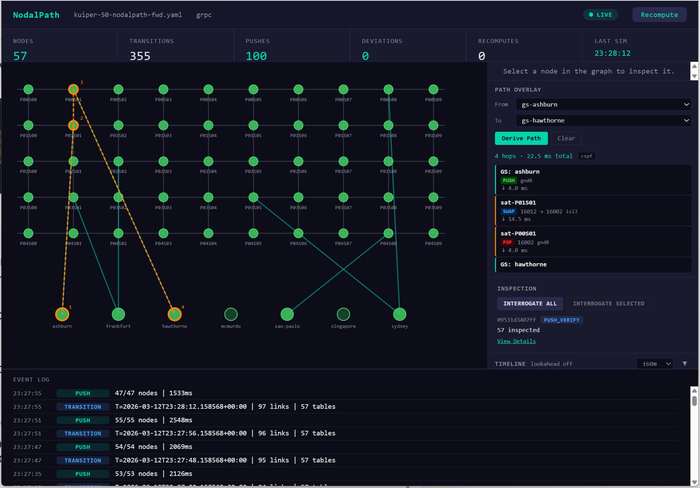
NodalArc — the first world NodalPath is built and tested against. It supplies the moving geometry, clock, and ground truth. NodalPath supplies the schedule and proves whether the network enacted it.