

The lab is set up. The session is clean. The constellation is running. The first thing the experiment notices is that the wireless mental model the routers brought with them does not fit.
Now picture yourself sitting still on your couch. Your link to the satellite overhead works for about four minutes. Then that satellite drops over the horizon and a different one comes up on the other side of the sky. The handoff still happens. You still did not initiate it. But this time you have not moved at all. The cell tower is the one that moved.
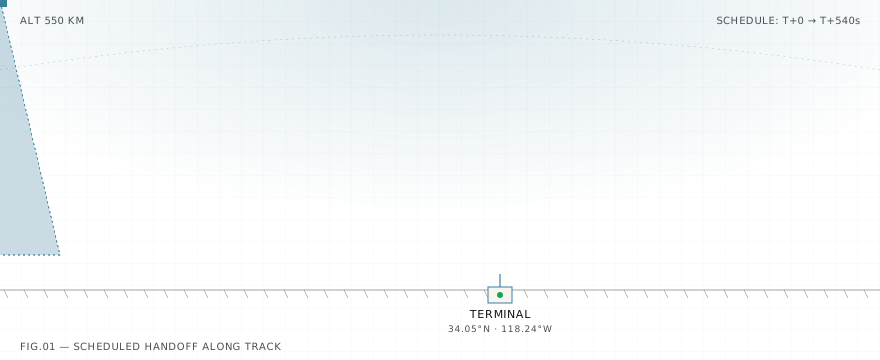
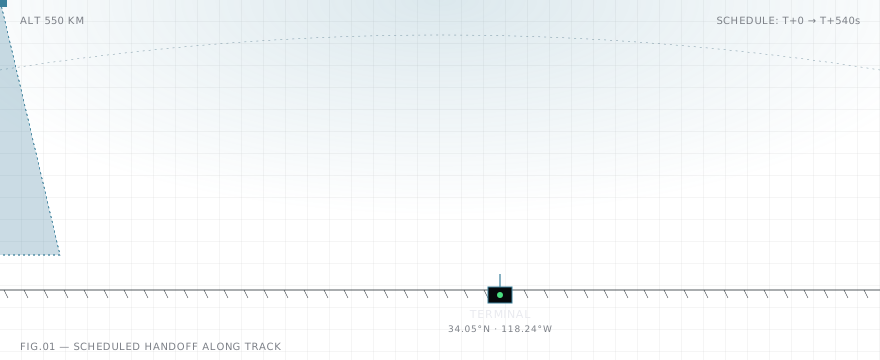
In orbit, the tower moves
In cellular and Wi-Fi, the infrastructure stays still. Cell towers stand on the ground at known coordinates. Wi-Fi access points sit on shelves in known buildings. Users move past them. The whole architecture of handoff, of cell sizing, of frequency reuse planning, of authentication and mobility management, is built on that arrangement. The user is the moving part. The network is the stationary frame.
In low Earth orbit it is the opposite. The infrastructure is moving at seven and a half kilometers a second. Each satellite traces an arc across the sky from horizon to horizon in something like fifteen to twenty minutes, depending on altitude and elevation angle. The user does not move at all. A ground station stays where it was built. A fixed terminal stays where it was installed. A parked vehicle stays parked. The network is the moving part. The user is the stationary frame.
The inversion is not a vocabulary curiosity. It rearranges how the rest of the wireless playbook lands.
Handoffs are scheduled
Take handoffs first. In cellular, a handoff is a reactive event. The user is moving. The network watches signal quality on the current cell and on neighboring cells. When one set of thresholds gets crossed, the network triggers a handover procedure. The user does not announce "I am about to leave this cell at 14:32:17." They cannot. They do not know.
In orbit, the user is not moving. The satellite is. The satellite's motion is not random; it is Keplerian. Given a satellite's orbital elements and a ground station's location, you can compute the rise time, the maximum elevation, and the set time of every pass for the next several days, to fractions of a second. The handoff is not a reactive event. It is a scheduled event. This is the determinism post 003 (The Future Is Computable) claimed for orbital networks. It surfaces here at the user's edge. The network knows exactly when the current satellite will drop below the horizon and exactly when the next one will become reachable.
That changes what you can do with the handoff.
The two modes
The two modes are named for what they do, and the names are worth remembering because they describe the trade-off.
Break-before-make is the simpler of the two. Tear down the link to the old satellite first. Bring up the link to the new one. There is a gap between the two. During that gap, the routing protocol on the ground station sees its uplink go down. It withdraws routes. It may flood a topology change. Then the new link comes up, the routing protocol forms a fresh adjacency, and the routes come back. The gap is short, often a fraction of a second on a healthy IGP. For bulk data that tolerates a brief interruption, BBM is enough; the application either retransmits the dropped packets or the user does not notice. For real-time traffic, the gap is felt as a stutter, a dropped voice frame, a stalled video.
BBM also has a practical advantage: it needs only one terminal on the ground station. The current satellite uses the terminal, then the next one uses it after the old one sets. One antenna, one tracking gimbal, one RF chain. For low-cost installations and mobile units where antenna count is the limiting cost, BBM is not a preference. It is the only mode the hardware supports.
Make-before-break is the mode you want when the application cannot tolerate a gap. Bring up the new link while the old one is still active. Move the traffic. Then tear down the old link. No gap. The link looks continuous to anything above the link layer.
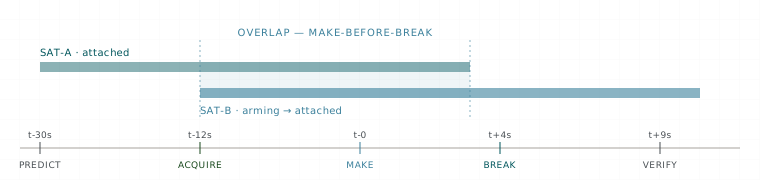
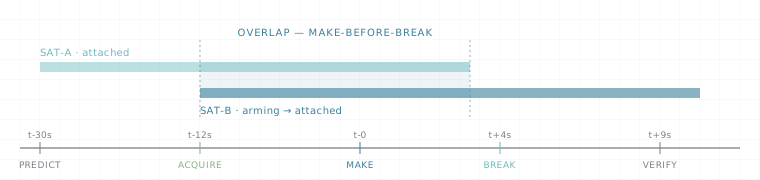
The cost is that MBB needs the ground station to maintain two links at once during the overlap window. Two satellites tracked simultaneously. Two antennas pointed in different directions. Two RF chains. Two adjacencies in the routing topology. The hardware has to support it. At least two terminals, each with its own tracking and pointing. Enough power budget to run both links. Enough frequency or polarization separation that the two active links do not interfere with each other. Not every deployment can absorb that cost. The ones that do typically host the kind of traffic that justifies it: live video, voice, interactive sessions, anything that breaks visibly if the link drops for half a second.
What MBB needs in orbit
Even with the hardware to do MBB, the orbital environment adds a requirement the cellular literature does not always emphasize: hysteresis.
Hysteresis is a term from physics and control systems. It describes a system whose state depends on its history, not just on its current input. The everyday example is a thermostat. Set the thermostat to seventy degrees Fahrenheit and the heater does not click on and off every time the room jiggles by a tenth of a degree. Instead, the thermostat has a small dead zone built in: it turns the heater on at sixty-nine and off at seventy-one. Two thresholds, not one. Without the dead zone, every passing draft would trigger a click. The heater would cycle thousands of times an hour without doing any useful work.
The same idea shows up wherever a system has to decide based on a noisy signal near a boundary: magnets, snap-action switches, electronic comparators. The principle is consistent. A system that looks only at its instantaneous input will oscillate when the input is near the threshold. A system that resists changing state without a real reason will not.
Handoffs are exactly this kind of decision. The signal is the satellite ranking score. The boundary is the cutover from one satellite to the next. The failure mode is not bad measurements. It is over-believing a near tie.
In handoff terms: when two satellites are competing for a ground station's attention, the choice should not flip every time their rankings cross by a hair. The current satellite gets a small bonus. The challenger has to earn the switch by clearing the bonus by a real margin. This is not a NodalArc invention. Real satellite and cellular systems have done some version of this for decades, under names like handover margin, dwell time, and minimum hold. NodalArc preserves the discipline in the emulator because the emulator would otherwise produce a brittleness that real moving RF systems do not have.
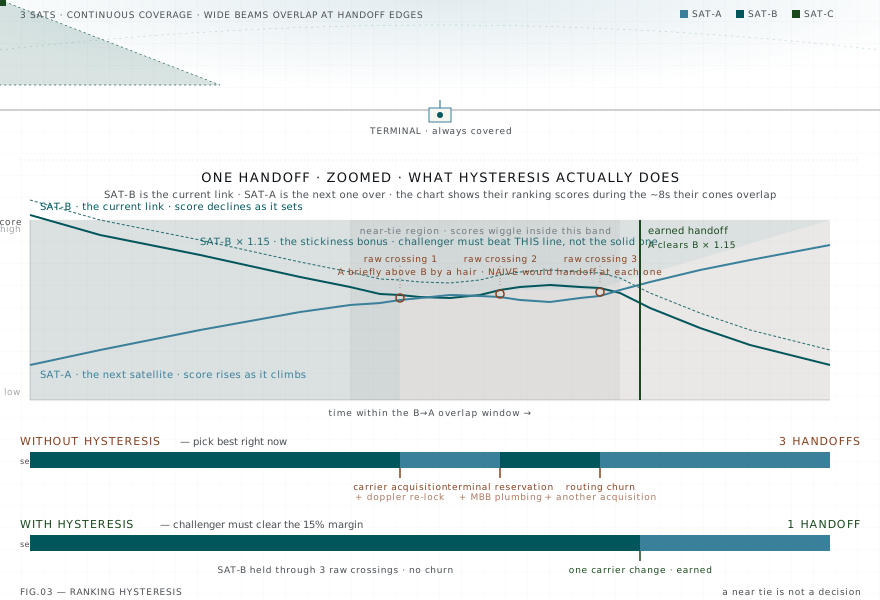
In a dense constellation, multiple satellites are often in view of the same ground station at the same time. The scheduling policy (highest-elevation, longest-remaining-pass, lowest-elevation) picks one as the current best. As the satellites move, two candidates can be near-equal for a stretch, and their rankings can cross more than once before one definitively pulls ahead. A naive scheduler treats every crossing as a command. Every flip is a handoff. Every handoff costs antenna motion, modem acquisition, terminal reservation, and routing churn. The link was never actually better on the other side; the system just could not tell.
The way NodalArc applies hysteresis is to give the currently-active link a score multiplier when ranking candidates. The default is 1.15. The incumbent's score is multiplied by 1.15 before the comparison. A challenger has to score at least 15% better than the incumbent to win the swap. That margin alone is not the whole story. If the discount stayed at 1.15 forever, the system would cling to a dying satellite past its useful pass. So the discount fades as the active link approaches the ground station's minimum elevation mask. The default fade range is five degrees: in the final five degrees before the satellite sets, the discount tapers to zero. The dying satellite stops getting the incumbency bonus, and the next satellite wins cleanly.
The controls live in the session YAML's scheduling block and (optionally) in each ground station's hysteresis block:
scheduling:
  ground:
    policy: highest-elevation
    handover_mode: mbb
    mbb_overlap_ticks: 3
    mbb_reserve: 1
ground_station:
name: ashburn
# ...
hysteresis:
discount_factor: 1.15
mask_fade_range_deg: 5.0handover_mode is the choice between BBM and MBB. mbb_overlap_ticks is how many ticks of overlap to maintain before tearing the old link down. mbb_reserve is the number of terminals the ground station keeps reserved for handling MBB overlaps. discount_factor is the incumbency bonus that prevents thrash. mask_fade_range_deg is the angular range over which the bonus tapers as the active satellite approaches its set time.
The physics gives you a scheduled handoff. The mode controls what happens at the moment of switching. The hysteresis controls whether the switch happens at all.
What else inverts
Once you see the inversion, the rest of the wireless playbook needs reconsidering.
The cellular cell has a fixed footprint and the user passes through it. The orbital cell is a satellite footprint that sweeps across the ground at orbital speed. Cell size in the cellular sense is meaningless. What matters is pass duration.
The cellular user roams. The orbital user does not. They sit on a couch. Their IP address does not change. The mobility lives entirely inside the satellite layer.
Frequency reuse planning, authentication zones, base-station siting, the whole operational stack built on "the user moves, the network stands still." All of it needs reconsidering. What survives is the part of wireless engineering that is really about physics: link budgets, antenna patterns, modulation choices, error correction. The physical layer does not care which end is moving.
Everything above it cares quite a lot.
post 009 (Forwarding Ahead of the Geometry) picks up the determinism payoff in earnest. If the future is computable and the handoffs are scheduled, the proactive-routing question that has been hanging since post 003 (The Future Is Computable) becomes actionable. NodalPath is the path we took.