

★ Experiments · Orbital Networking · v0.3
Experiments in orbital networking.
What happens to the network when you put your routers on orbit. NodalArc is the emulation platform we built to ask that question; NodalPath is what we built once the question had an answer worth shipping.
Featured
latest · #015Fit for Purpose
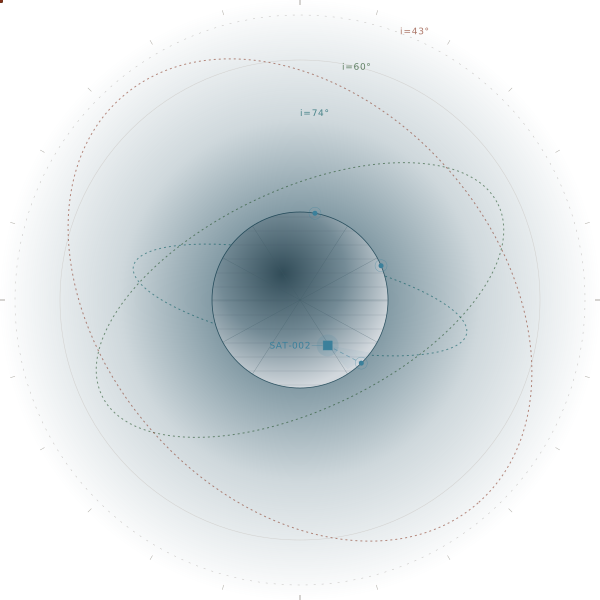
A propagator turns a state photograph into motion. Why propagation models exist, the trajectory sources NodalArc speaks, and a correctness standard measured at the network boundary instead of in kilometers.
read post →Fig · where the error lands
Archive
15 posts
#015
Aug 2026
Foundation
Fit for Purpose
›
#014
Aug 2026
Foundation
Relative to What
›
#013
Jul 2026
Foundation
Which Map, Which Clock
›
#012
Jun 2026
Foundation
Custody Is Not Connectivity
›
#011
May 2026
Configuration
The Grammar Had To Grow
›
#010
Mar 2026
Configuration
Worlds, Not Constellations
›
#009
Feb 2026
Engineering
Forwarding Ahead of the Geometry
›
#008
Jan 2026
Mobility
The Tower Is the One Moving
›
#007
Jan 2026
Configuration
The YAML Is The Contract
›
#006
Jan 2026
Configuration
One Idea Per File
›
#005
Dec 2025
Engineering
The Lab Is a Network
›
#004
Dec 2025
Engineering
Between the Sky and the Kernel
›
#003
Nov 2025
Engineering
The Future Is Computable
›
#002
Nov 2025
Constellations
Addressing the Geometry Problem
›
#001
Oct 2025
Foundation
Fit the First: The Terrestrial Assumption Problem
›